
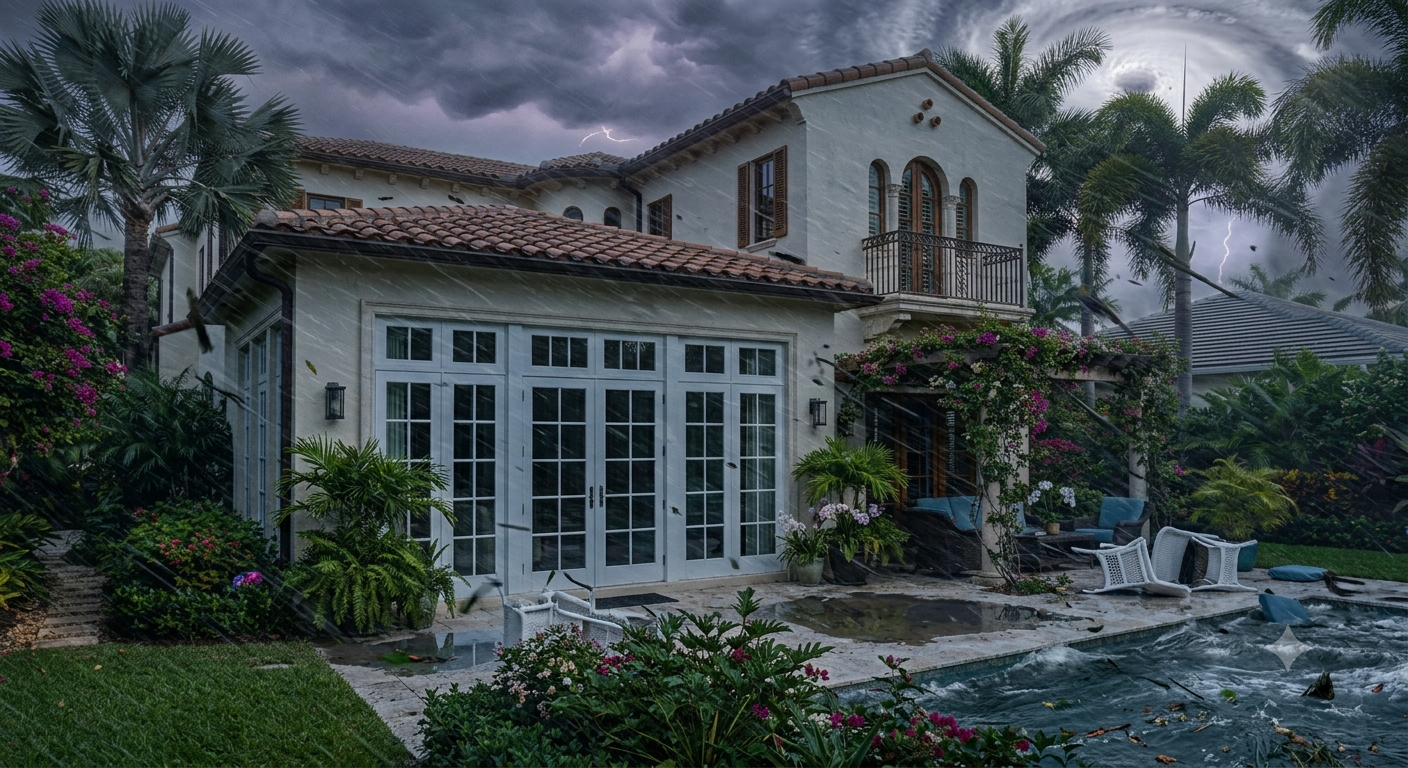
French doors are one of the most popular design choices in Miami homes. They let in natural light, open up sightlines between indoor living spaces and outdoor patios, and add a level of architectural elegance that solid entry doors simply cannot match. But in South Florida’s High Velocity Hurricane Zone, standard French doors are also one of the most vulnerable points in a home’s exterior envelope.
A conventional French door with large glass panels offers little resistance to hurricane-force wind pressure or the flying debris that comes with it. A storm breach at that opening puts the entire interior of the home at risk. That is why hurricane impact French doors installation has become standard practice for Miami-Dade homeowners who want the look of French doors without sacrificing the protection their climate demands.
This guide explains how the installation process works from start to finish, what makes impact French doors different from standard models, how the cost compares to hurricane impact sliding doors installation, and what to expect at every stage of the project.
What Are Hurricane Impact French Doors?
Hurricane impact French doors are double-panel hinged doors engineered to pass the most rigorous storm-resistance testing standards in the country. Unlike standard French doors where a single broken glass panel compromises the entire door, impact French doors are built around a layered construction that holds together even when struck by windborne debris.
The two core components that make this possible are:
Impact-laminated glass. Each glass panel in a hurricane-rated French door consists of two or more panes of tempered glass bonded around a polyvinyl butyral (PVB) or ionoplast interlayer. When struck, the glass may crack, but the interlayer holds the fragments in place and maintains the door’s structural barrier. This is the same technology used in automotive windshields.
Reinforced frames. The frame system carries as much of the door’s storm performance as the glass itself. Impact French door frames are manufactured from heavy-gauge aluminum, fiberglass, or reinforced vinyl, anchored to the home’s structural framing with specialized fasteners that distribute wind load pressure across a wide area rather than concentrating it at a few points.
To be sold and installed in Miami-Dade County, impact French doors must carry a Miami-Dade Notice of Acceptance (NOA) and pass ASTM E1886 and ASTM E1996 testing, which simulate both large missile impact and cyclic pressure loading during hurricane conditions. These are the strictest product approval standards in the United States.
French Impact Doors vs. Hurricane Impact Sliding Doors
Both French doors and sliding doors can be manufactured to hurricane impact standards, and both are widely used in Miami-Dade homes. The choice between them usually comes down to space, aesthetics, and how the opening will be used.
Hurricane impact French doors open on hinges and swing inward or outward. They create a full, unobstructed opening when both panels are open, which works well for entertaining spaces, pool access points, and wide patio connections. The hinged design provides a tighter seal against wind-driven rain than most sliding systems and is generally considered the more elegant option. They require clear swing space on one or both sides of the opening.
Hurricane impact sliding doors installation involves panels that glide along a track system rather than swinging open. Sliding doors are the better fit for spaces where a swing arc would create a functional problem, such as a narrow patio, an area with furniture close to the door, or an opening adjacent to a pool deck. Impact sliding doors in Miami typically cost less than impact French doors because the track-and-roller system is less mechanically complex than a multi-point hinge system engineered to hurricane standards.
Both types require the same Miami-Dade NOA approval, the same permit process, and the same licensed installation. The installation steps diverge primarily in how the door unit is framed, anchored, and sealed within the opening.
Impact Door Installation Cost in Miami, FL
Cost is one of the first questions homeowners ask, and the honest answer is that impact French doors sit at the higher end of the impact door market. Several variables drive the final number.
Door unit cost. Impact French doors for a standard residential opening (typically 72 by 80 inches) generally run between $1,500 and $5,500 for the door unit itself, before installation. Custom sizes, premium finishes, decorative glass patterns, and sidelite panels push costs toward the top of that range and beyond.
Installation labor. Labor costs in Miami for impact French door installation run $800 to $1,200 per opening for a standard replacement in an existing rough opening. Older homes or openings that require structural modification to accommodate new frame dimensions sit at the higher end. Masonry homes, which are common in South Florida, often require additional anchoring work that adds to labor time and cost.
Permits and inspections. Miami-Dade building permits for door replacement are required on every project. Permit fees vary by municipality but typically add $100 to $400 to the project cost. Inspections are included as part of the permit process.
Total installed cost. Most Miami homeowners pay between $2,500 and $7,000 per opening for hurricane impact French doors fully installed and permitted. Complex openings, custom door configurations, or projects that require structural work at the rough opening push beyond that range.
Hurricane impact sliding doors installation costs less on average. Impact sliding door units for a standard patio opening run $1,000 to $3,500 for the unit, with installed totals typically landing between $1,800 and $5,000 depending on size and configuration.
Insurance premium reductions offset some of the upfront cost. Most Florida homeowners insurance carriers offer wind mitigation credits for homes with verified impact-rated openings carrying Miami-Dade NOA certification. Discounts commonly range from 10 to 45 percent on the wind portion of the premium, depending on the policy and the number of protected openings in the home.
Permits and Code Requirements in Miami-Dade
No hurricane impact French door installation in Miami-Dade County can legally proceed without a building permit. This requirement applies to both replacements and new openings.
The permitting process involves submitting product specifications confirming the door carries Miami-Dade NOA approval, a description of the installation method, and in some cases structural calculations for the anchoring system. A licensed contractor handles this submission on behalf of the homeowner.
Once the permit is issued, a Miami-Dade building inspector must approve the completed installation before the permit is closed. This inspection confirms that the door was installed according to its approved NOA specifications, including proper fastener placement, sealant application, and frame anchoring.
Skipping the permit is not a practical option for homeowners in Miami-Dade. An unpermitted door installation creates problems at resale, can void homeowner’s insurance coverage for storm damage, and may require the door to be removed and reinstalled if discovered during a future inspection.
How Hurricane Impact French Doors Are Installed: Step by Step
Step 1: Measurement and Product Selection
The installation process begins before any tools come out. A licensed installer measures the existing rough opening precisely, accounting for width, height, squareness, and the condition of the surrounding framing. In Miami-Dade, masonry block construction is common, and the measurement process for a masonry opening differs from a wood-framed opening because the anchoring method and frame depth requirements change.
Based on the measurements, the installer and homeowner select the door unit. Key decisions at this stage include:
- Frame material (aluminum is the most common for coastal South Florida due to its corrosion resistance; fiberglass is also a strong option)
- Glass type (standard impact laminate vs. Low-E impact glass, which adds energy efficiency by reducing solar heat gain)
- Swing direction (inswing vs. outswing; outswing is common in Miami because it resists positive wind pressure more effectively)
- Hardware and locking system (multi-point locking systems are standard on impact French doors and provide better weather sealing than single-point locks)
- Finish and color
The door is typically ordered from the manufacturer after measurement. Lead times for standard sizes generally run two to four weeks. Custom configurations take longer.
Step 2: Permitting
With the product selected and specifications confirmed, the licensed contractor submits the permit application to the Miami-Dade Building Department or the applicable municipal building department. The application includes the door’s NOA number, installation drawings, and any required structural documentation.
Permit approval times in Miami-Dade vary. Standard residential replacements are often approved within a few days through the online portal. More complex projects involving structural modifications or historic properties take longer.
Step 3: Removal of the Existing Door
On installation day, the crew begins by carefully removing the existing door and its frame from the opening. For masonry homes, this involves cutting through the stucco and sealant around the frame perimeter and removing the fasteners anchoring the old frame to the block or concrete structure.
The crew inspects the rough opening and surrounding framing after removal. Any wood rot, deterioration of the buck (the wood or treated lumber framing embedded in the masonry), or structural damage to the opening must be repaired before the new door is set. Skipping this step allows moisture to continue entering through the same compromised area, even with a new door in place.
Step 4: Rough Opening Preparation
The rough opening is cleaned of debris, old sealant, and deteriorated caulk. The installer checks the opening for level, plumb, and square. A rough opening that is out of square by more than a small margin needs to be corrected before the new frame is set. An out-of-square installation prevents the door panels from sealing and operating correctly and can void the door’s product approval.
For masonry construction, the installer verifies that the buck is solid and properly anchored to the surrounding block. If the buck has deteriorated, it is replaced with pressure-treated lumber before the door frame is installed.
Step 5: Setting the Door Frame
The impact French door frame is set into the prepared opening and shimmed to achieve plumb, level, and square alignment. Proper alignment at this stage determines how well the door will operate and seal for the life of the installation.
Once aligned, the frame is anchored to the surrounding structure. In masonry construction, this involves drilling through the frame into the block or concrete and setting fasteners per the door’s NOA-approved installation specifications. The NOA specifies the fastener type, diameter, embedment depth, and spacing required to achieve the door’s rated wind load performance. Deviation from those specifications means the door will not perform to its rated standard in a storm, regardless of how it looks from the outside.
In wood-frame construction, the frame is typically lag-bolted through the frame into the structural framing members at specified intervals.
Step 6: Installing the Door Panels and Hardware
With the frame anchored, the door panels are hung on the hinges and adjusted for proper operation. Both panels must close fully, latch smoothly, and compress the weatherstripping evenly across the full frame perimeter. Multi-point locking hardware is installed and adjusted so all locking points engage simultaneously when the door is locked.
The active panel (the one that opens first) is adjusted for smooth swing and proper engagement with the astragal, the vertical strip between the two panels that provides the weather seal where they meet in the center.
Step 7: Sealing and Weatherproofing
All gaps between the door frame and the surrounding wall are sealed with approved sealant applied in a continuous, unbroken bead. On stucco masonry homes, the stucco is patched and blended into the new frame perimeter. Proper sealant application is critical in South Florida because wind-driven rain during a storm will find even small gaps and drive water into the wall assembly.
Weep holes on the frame sill, which drain any water that enters the frame system during driving rain, are verified to be clear and unobstructed.
Step 8: Final Inspection
The permit inspection is scheduled once installation is complete. The Miami-Dade inspector reviews the anchoring, sealant, product approval documentation, and overall installation quality. A passing inspection closes the permit and confirms that the installation meets current code.
The homeowner receives copies of the permit and inspection record, which should be kept on file. These documents are required when applying for wind mitigation insurance credits and are also requested by buyers during real estate transactions.
Miami-Specific Considerations
HVHZ standards. Miami-Dade and Broward counties are designated as a High Velocity Hurricane Zone under the Florida Building Code. Every impact door product installed in the HVHZ must carry Miami-Dade NOA approval, not just generic Florida product approval. NOA-certified products have passed more rigorous testing than those approved only at the state level.
Masonry construction. Most Miami homes built before the 1990s and many built since use concrete block or poured concrete construction. Anchoring impact doors into masonry requires different fastener types and installation techniques than wood-frame construction. Contractors who specialize in impact door installation in Miami have the equipment and experience for masonry work; general contractors who do not regularly install impact products in South Florida may not.
Outswing vs. inswing. Florida Building Code allows both inswing and outswing configurations for impact French doors, but outswing doors resist positive wind pressure more naturally because the door presses against the frame stop when wind pushes from outside. Many South Florida installers default to outswing for exterior-facing openings, particularly those exposed to prevailing storm wind directions.
Salt air and frame material. Homes within a mile or two of the coast should prioritize aluminum or fiberglass frames over steel or untreated wood. Salt air accelerates corrosion on ferrous metals. Aluminum frames with a powder-coated finish and marine-grade hardware are the standard recommendation for Miami Beach, Key Biscayne, Coconut Grove, and similar coastal neighborhoods.
Energy efficiency. Miami’s cooling costs are significant. Impact French doors with Low-E glass reduce solar heat gain through the glass panels, which lowers air conditioning load on rooms with southern or western exposure. The added cost of Low-E glass over standard impact laminate is typically recovered through energy savings within a few years in Miami’s climate.
The Right Installation Makes the Difference
A hurricane impact French door is only as effective as its installation. The door’s rated wind load performance depends on the frame being anchored exactly as specified in the NOA, the sealant being applied continuously and correctly, and the inspection confirming that nothing was missed. A door installed without a permit, by a contractor unfamiliar with Miami-Dade masonry anchoring requirements, or with sealant gaps in the frame perimeter will not perform the way it was engineered to perform when a storm arrives.
For Miami homeowners, that gap between a door that looks right and one that is installed right matters in a way it does not in most other parts of the country. Getting the installation done correctly the first time, by a licensed contractor who pulls the permit and passes the inspection, is the standard that protects both the home and the investment.
Unity Windows & Doors installs hurricane impact French doors, sliding doors, and entry doors across Miami-Dade, with every project permitted and inspected to current code. Contact our team to schedule a free consultation.
Frequently Asked Questions
What is the difference between impact French doors and standard French doors?
Standard French doors use single-pane or non-laminated glass that shatters on impact, leaving a large breach in the home’s exterior. Impact French doors use laminated glass with a bonded interlayer that holds together when struck. The frames are also reinforced and anchored to withstand hurricane-level wind pressure, meeting Miami-Dade NOA certification standards.
Do I need a permit to install hurricane impact French doors in Miami?
es. A building permit is required for every impact door installation in Miami-Dade County. The permit process includes product approval documentation and a post-installation inspection. A licensed contractor handles the permit submission.
How much does impact door installation cost in Miami?
Most Miami homeowners pay between $2,500 and $7,000 per opening for hurricane impact French doors fully installed and permitted. Impact sliding door installations typically run $1,800 to $5,000 for a standard patio opening. Costs vary based on door size, frame material, glass type, and whether the rough opening requires structural modification.
Can hurricane impact French doors open inward or outward?
Both configurations are permitted under the Florida Building Code. Outswing is the more common choice for exterior-facing openings in South Florida because it provides stronger resistance to positive wind pressure during a storm.
How long does hurricane impact French door installation take?
The physical installation of a standard replacement typically takes one full day for a professional crew. The full project timeline, from permit submission to final inspection, is generally four to six weeks, with most of that time accounted for by permit review and the door manufacturing lead time.
Will impact French doors lower my homeowner’s insurance premium?
Most Florida insurance carriers offer wind mitigation credits for homes with NOA-certified impact openings. The discount depends on how many openings are protected and the policy structure, but reductions of 10 to 45 percent on the wind portion of the premium are common.