
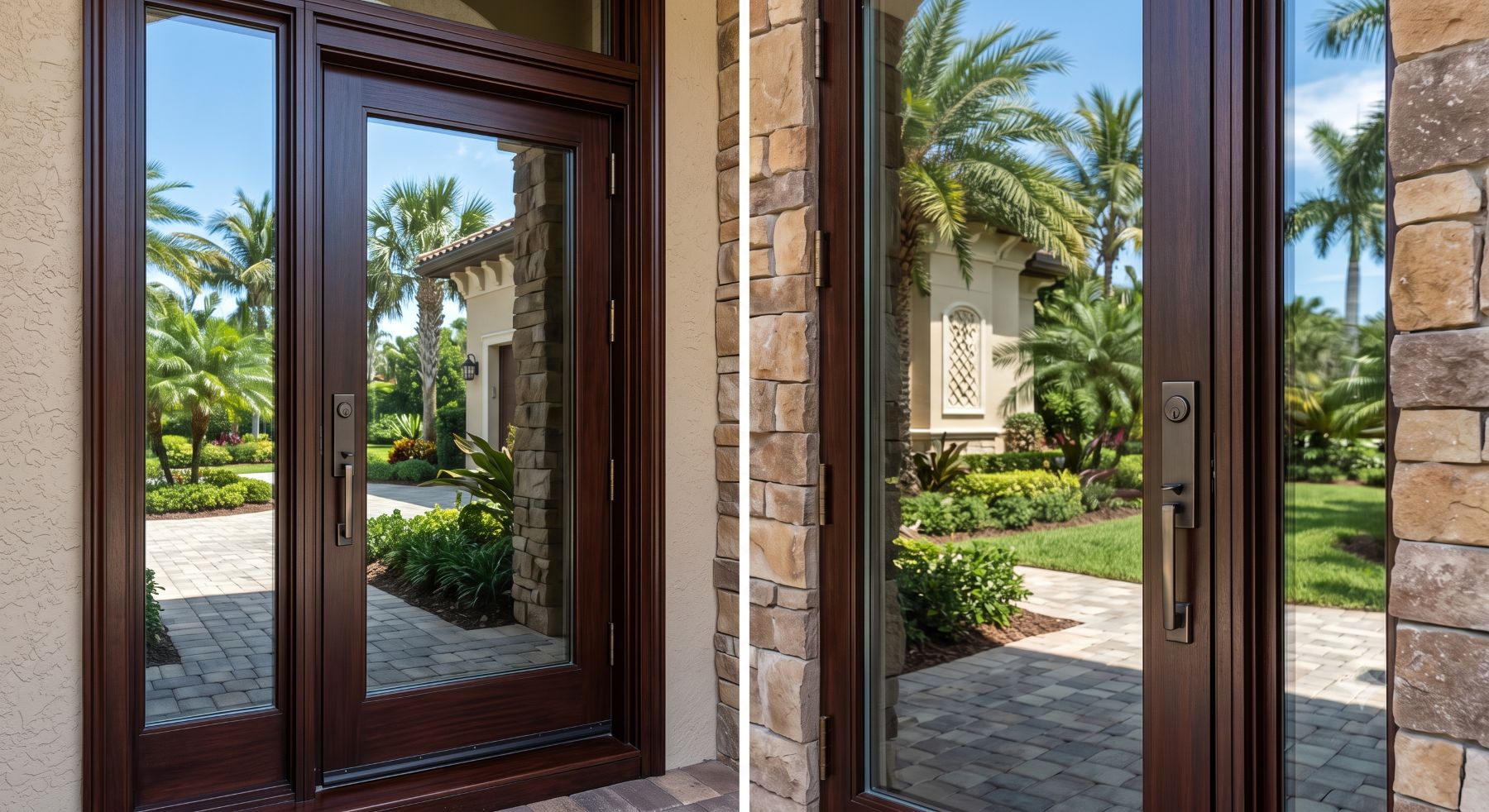
Your front door is the first thing visitors see and the first line of defense your home puts up against a storm. In Miami-Dade, those two demands sit on the same door. It has to look like it belongs on your home while standing up to the kind of wind pressure and flying debris that destroys conventional entry doors in minutes during a major hurricane.
Hurricane impact front doors with glass have become the standard answer to that problem across South Florida. They are built to carry both functions without compromise: serious storm protection wrapped in a product that looks designed rather than defensive. This guide explains what they are, how they are built, what the glass configurations actually mean for your home, how much they cost, and whether the investment makes sense for Miami homeowners.
What Is an Impact Door?
An impact door is a door system engineered to withstand hurricane-force wind pressure and windborne debris impact without failing structurally. The definition matters because the word “hurricane door” gets used loosely in the market, and not every door that claims storm resistance is actually built to the standard Miami-Dade requires.
A true impact door is a tested system, not just a heavy door with thick glass bolted into a frame. Every impact-rated door is part of a tested system that includes the glass, frame, anchoring hardware, and installation method. Change any one of those components for a non-rated substitute and the system no longer qualifies for Miami-Dade NOA certification, regardless of how the rest of the door is built.
To be sold and installed in Miami-Dade County, an impact front door must carry a Miami-Dade Notice of Acceptance (NOA). The product must pass TAS 201 missile impact testing, TAS 202 structural load testing, and TAS 203 cyclic pressure testing. Standard hurricane-rated entry doors with only a Florida Product Approval are not sufficient for the HVHZ.
The large missile impact test that Miami-Dade requires fires a nine-pound, two-by-four timber at the door at 50 feet per second. Products that hold together after that strike and then survive thousands of cyclic pressure cycles earn the NOA. That is the benchmark every door installed in Miami-Dade must meet.
Why the Front Door Matters More Than Most Openings
Every opening in a home’s exterior envelope is a potential breach point during a hurricane. But the front door carries more structural consequence than most windows. A front door faces direct wind exposure, takes the full force of windborne debris on the windward side of the building, and is structurally critical to maintaining the building’s envelope during a hurricane. If a front door fails, wind enters, internal pressure builds to 30 to 60 PSF, and combined with external roof suction of 40 to 80 PSF, the resulting 70 to 140 PSF of uplift can tear the roof off from the inside.
That is not a worst-case hypothetical. It is the documented failure sequence that happens repeatedly during major South Florida storms when non-impact front doors give way. The roof does not always fail because wind got under the eaves. It fails because the interior pressure spiked when the front door blew out.
Impact front doors prevent that sequence by keeping the building envelope intact through the duration of the storm.
Hurricane Impact Front Doors with Glass: Understanding the Glass Options
The glass configuration on an impact front door is where aesthetics and performance intersect. Miami homeowners have more design choices than most people expect, and none of those choices require trading hurricane protection for appearance.
How Impact Glass Works
Hurricane impact glass consists of laminated safety glass with polyvinyl butyral (PVB) interlayers that maintain structural integrity even after impact damage. When debris strikes the glass, the pane may crack but the interlayer holds the fragments together. No breach. No sudden pressure spike inside the home.
Hurricane-resistant glass will not shatter or crack entirely in the event of a hurricane. Regular glass will almost always crack and shatter completely, causing air and water infiltration, risk of injury, and debris entering the home.
Glass Panel Configurations
Full-lite doors have a glass panel that runs the full height of the door. They maximize natural light and work well in contemporary and modern architectural styles. The entire panel is impact-rated laminated glass, so the visual openness does not reduce storm performance.
Half-lite doors have a glass panel in the upper half with a solid panel below. They balance natural light with privacy and are the most versatile configuration across architectural styles, from traditional to transitional to modern.
Three-lite and six-lite doors have a divided upper panel of smaller glass panes set within a solid door. This configuration with a divided lite upper panel over a solid lower panel creates strong horizontal lines and is popular in bungalow, arts-and-crafts, and transitional home styles.
Sidelights are vertical glass panels flanking the door on one or both sides. Sidelights must be impact-rated to the same standard as the door itself. In the HVHZ, sidelights require Miami-Dade NOA certification. Adding sidelights significantly broadens the entryway visually, which is one of the most effective ways to upgrade a home’s street presence without altering the structural opening.
Transoms are glass panels above the door. Like sidelights, they must be separately impact-rated and code-compliant for the HVHZ.
Decorative and Specialty Glass
Decorative glass options include textured, frosted, rain glass, etched patterns, wrought iron between glass lites, and privacy glass. These aesthetic treatments are applied to impact-rated laminated glass, so the decorative element does not reduce the hurricane protection level.
Low-E coatings are also available on impact glass and are worth considering for Miami homes. Low-E coatings reflect infrared solar radiation while transmitting visible light, which reduces heat gain through the glass panels and lowers the cooling load on rooms with southern or western exposure.
Frame Materials: What Works in Miami’s Climate
The frame material affects everything from hurricane resistance to thermal performance and long-term maintenance. In Florida’s coastal and humid climate, not all materials hold up equally.
Fiberglass is the most popular frame material for impact front doors in South Florida. Fiberglass impact front doors are the most popular choice: they offer the best insulation, wood-grain aesthetics, and lowest maintenance. Fiberglass does not conduct heat the way aluminum does, does not rust, and does not warp in Miami’s year-round heat and humidity. It can be molded into arch-top designs and stained to resemble mahogany, walnut, or other wood tones without any of wood’s maintenance requirements.
Aluminum is the stronger structural choice for high-wind applications and large glass panel configurations. Aluminum entry doors use extruded 6063 alloy frames with laminated impact glass and reinforced panel construction. They achieve the highest design pressure ratings of any entry door material and provide the thinnest profiles, maximizing glass area for full-lite and sidelight configurations. For homes near the coast, a powder-coated finish with a Kynar or PVDF coating provides the best resistance to salt air corrosion. Aluminum frames conduct heat more readily than fiberglass, so a thermally broken frame, which incorporates an insulating barrier within the frame profile, is worth specifying for exterior-facing doors with significant sun exposure.
Wood is not recommended for most Miami homes. Heat, humidity, and frequent rain cause warping, cracking, and paint failure that demands constant maintenance. Engineered wood and wood-clad options perform better than solid wood but still require more upkeep than fiberglass or aluminum in South Florida’s climate.
French Impact Doors as a Front Entry Option
French impact doors, typically understood as double-panel hinged doors with large glass panels, are one of the more dramatic entry door choices available in the Miami market. They work well on homes where the architectural scale supports a wide entry and where natural light and visual connection between foyer and exterior are design priorities.
For front entry applications, French impact doors are most common on Mediterranean-revival and transitional-style homes, which are well-represented across Miami-Dade’s residential neighborhoods. The double-panel configuration creates a full, unobstructed opening when both panels are open, which works well for homes where the front entry also serves as a formal entertaining entrance.
French impact doors require multi-point locking hardware on both the active and inactive panels to achieve the frame seal required for Miami-Dade NOA certification. Single-point deadbolts are not adequate for a door of this size under hurricane wind pressure. The active panel latches at the top, bottom, and side; the inactive panel is secured at the top and bottom with surface bolts or a flush bolt system before the active panel latches against it.
Because both panels carry laminated glass, French impact doors at the front entry bring substantial natural light into the foyer without any reduction in storm protection.
Are Impact Doors Worth It in Miami?
For Miami-Dade homeowners, the question is less about whether impact doors are worth it and more about which opening to prioritize if budget requires phasing the project.
Here is what the investment actually delivers:
Storm protection that is always active. Unlike shutters, impact doors require no preparation before a storm and no cleanup after. The protection is built into the door itself and is present every day, not just during hurricane season.
Insurance premium reductions. Florida homeowners insurance carriers offer wind mitigation credits for homes with verified NOA-certified impact protection on all openings. The discount depends on how many openings are protected, but meaningful reductions on the wind portion of the premium are standard across most policies. Homes with complete impact protection, including front entry doors, windows, and patio doors, typically qualify for the maximum wind mitigation credit available under their policy.
Security against forced entry. The same laminated glass and reinforced frame that stops hurricane debris stops opportunistic break-in attempts. A standard front door glass panel shatters on a single strike. An impact glass panel holds together, requiring sustained and noisy effort to breach. Multi-point locking systems add mechanical resistance that single-deadbolt doors cannot match.
Energy efficiency. Impact front doors with insulated cores and Low-E glass reduce heat transfer through the entry opening. In Miami homes where the front door faces south or west, this reduces the heat load on the air conditioning system in that zone of the house.
Property value and marketability. Impact-rated entry doors are a verified selling point in the South Florida real estate market. Buyers actively seek homes with full impact protection because they understand the alternative is absorbing that cost themselves after purchase.
The front door is also the opening with the most visual impact on a home’s curb appeal. A well-chosen impact front door with glass does not look like storm hardware. It looks like a design decision.
Hurricane Impact Doors Cost in Miami, FL
Cost varies based on door size, frame material, glass configuration, and whether sidelights or a transom are included in the system.
Door unit cost. Fiberglass impact front doors range from $2,000 to $4,500. Aluminum impact front doors range from $2,500 to $6,000. Custom arch-top configurations, specialty glass, and sidelight additions push costs beyond those ranges. A full entry system with a door, two sidelights, and a transom in a premium aluminum frame with decorative impact glass represents a significantly larger investment than a standard single door.
Installation labor. Licensed installer labor in Miami for a standard impact front door replacement runs $600 to $1,000 for the installation itself. Openings that require structural modification, masonry anchoring work, or stucco repair around the new frame sit at the higher end or above.
Permits and inspections. A Miami-Dade building permit is required for every impact door installation. Permit fees typically add $100 to $400 to the project cost depending on the municipality.
Total installed cost. Most Miami homeowners pay between $2,500 and $7,500 for a hurricane impact front door fully installed and permitted, with standard single-door configurations at the lower end and larger systems with sidelights, transoms, or premium material and glass choices at the upper end and beyond.
These costs should be evaluated against the combination of insurance premium reductions, avoided storm damage risk, and the security and energy efficiency improvements the door provides over its service life.
What to Check Before You Buy
Not all doors marketed as “hurricane impact” or “storm rated” meet Miami-Dade’s requirements. Before purchasing any impact front door for a Miami-Dade home, confirm the following:
NOA number. Every door sold for installation in the HVHZ must carry a Miami-Dade NOA. Ask for the NOA number and verify it yourself at the Miami-Dade Building Department’s product control database. A door without a verifiable NOA number is not code-compliant for Miami-Dade installation.
System certification. The NOA covers the door as a tested system, including the specific glass, frame, hardware, and installation method. Substituting any non-rated component voids the system certification.
Contractor license. Impact door installation in Florida requires a licensed contractor. An unlicensed installation voids the wind mitigation insurance credit and can require the door to be removed and reinstalled if discovered during a future inspection or real estate transaction.
Threshold and weatherstripping. The door threshold is a common water intrusion point during hurricanes. Look for an adjustable threshold that allows fine-tuning the seal between the door bottom and the threshold after installation, and compression weatherstripping on all four sides.
Multi-point locking hardware. Single-point deadbolts are a structural weak point under sustained wind pressure. Multi-point locking systems that engage at three to five points along the frame perimeter are standard on NOA-certified impact front doors and should not be substituted for cost savings.
The Entry Your Home Deserves, Built for Where It Lives
A hurricane impact front door with glass is not a compromise between how your home looks and how it is protected. In Miami, where the building code demands performance and the real estate market rewards curb appeal, the best impact doors deliver both without asking you to choose.
The glass configuration, frame material, and locking system you select shape both the appearance and the long-term performance of the door. Getting those choices right, with products that carry verified Miami-Dade NOA certification and installation by a licensed contractor who pulls the permit, is what separates a door that looks the part from one that actually does the job when a storm arrives.
Unity Windows & Doors installs hurricane impact front doors, French doors, and full entry systems across Miami-Dade, with every project permitted and inspected to current code. Contact our team to schedule a free consultation.
Frequently Asked Questions
What is an impact door? An impact door is a door system built from laminated glass and reinforced frames, tested and certified to withstand hurricane-force wind pressure and large missile debris impact. In Miami-Dade County, every impact door must carry a Miami-Dade NOA certification to be code-compliant.
Can I get an impact front door with decorative glass? Yes. Decorative glass options including frosted, textured, rain glass, etched patterns, and privacy glass are all available applied to impact-rated laminated glass. The decorative treatment does not reduce the door’s hurricane protection rating.
Are French impact doors suitable for front entries? Yes. French impact doors work well as front entry doors, particularly on Mediterranean-revival and transitional-style homes. They require multi-point locking hardware on both panels and must carry Miami-Dade NOA certification for installation in the HVHZ.
How much do hurricane impact doors cost in Miami? Most Miami homeowners pay between $2,500 and $7,500 for a standard hurricane impact front door fully installed and permitted. Larger configurations with sidelights, transoms, or custom arch-top designs sit above that range.
Are impact doors worth it in Miami? Yes, consistently. The combination of always-active storm protection, insurance premium reductions, forced entry resistance, energy efficiency improvements, and increased property value makes impact doors one of the strongest ROI home improvements available to Miami-Dade homeowners.
Do I need a permit to replace my front door with an impact door in Miami? Yes. A building permit is required for every impact door installation in Miami-Dade County. The permit process includes product approval documentation and a post-installation inspection. A licensed contractor manages the permit submission.