
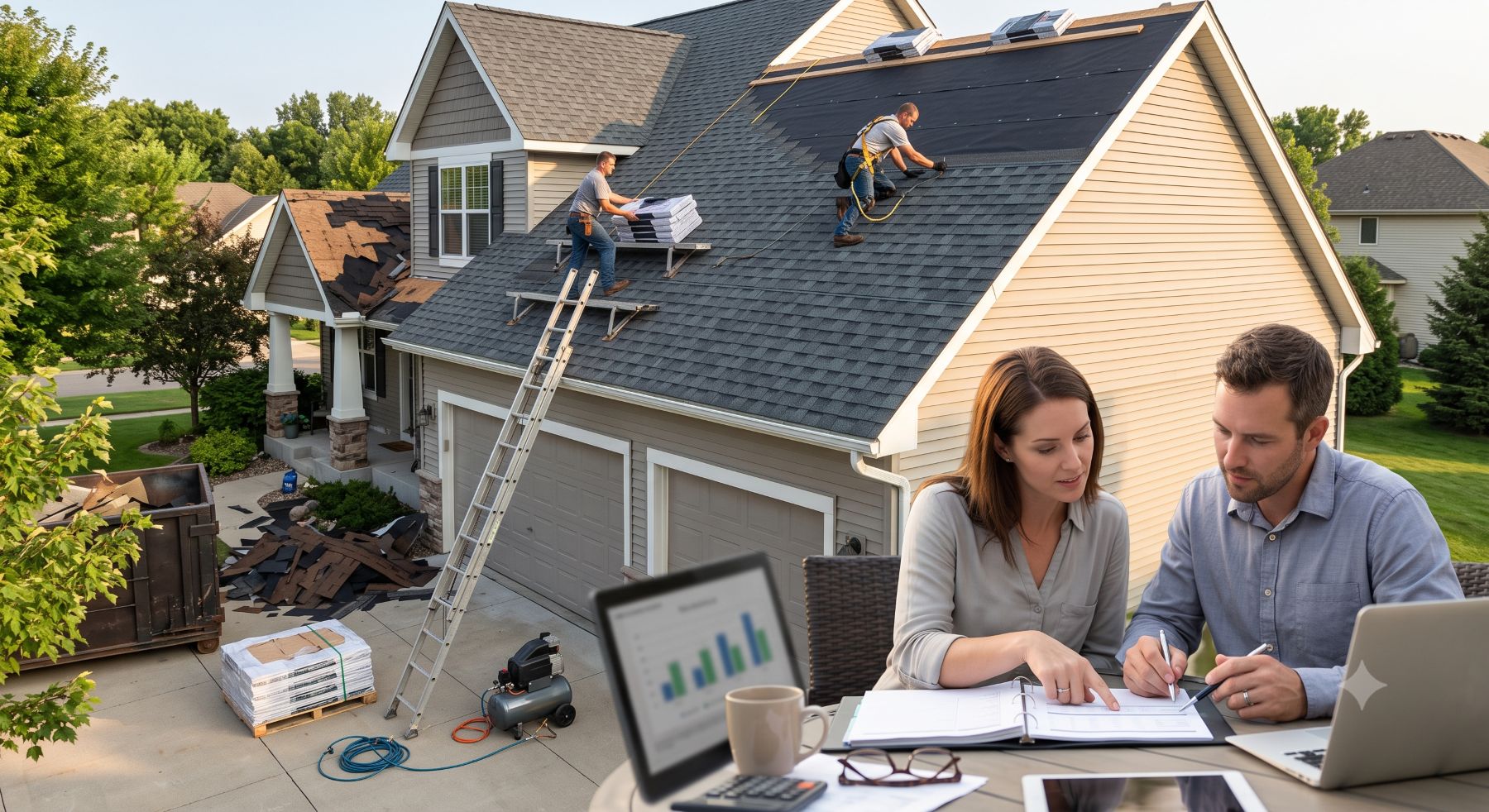
A roof replacement is one of the largest single expenses most homeowners will face, and it almost never happens on a convenient schedule. Whether a storm forces the issue, an inspector flags a failure, or an aging roof finally gives out, the cost lands fast and demands a decision.
In 2026, the average roof replacement runs between $8,000 and $25,000 for most residential homes, with costs rising toward $35,000 and beyond for larger properties or premium materials. Few homeowners have that sitting in a savings account earmarked for roofing. Financing a roof replacement is not a sign of financial difficulty; it is how most homeowners manage a large, non-negotiable capital expense while keeping their emergency fund intact.
This guide breaks down every viable option for how to finance a roof replacement, including what works when your credit is not perfect, so you can make a clear-eyed decision before a contractor shows up at your door.
Before You Finance: Check Your Insurance First
Before applying for any loan, check your homeowner’s insurance policy. If the roof damage was caused by a covered peril, including wind, hail, a fallen tree, or storm-related debris, your insurer may pay for part or all of the replacement cost. Filing a claim first can significantly reduce or eliminate the amount you need to borrow.
Insurance typically covers sudden, event-specific damage. It does not cover normal wear and tear, gradual deterioration, or roofs that have simply reached the end of their service life. If your roof is aging out rather than storm-damaged, financing will be your primary tool.
If insurance does apply, you will still be responsible for your deductible, which commonly runs $1,000 to $2,500, and sometimes higher for wind or hail-specific deductible provisions. Many homeowners finance the deductible portion or the gap between the insurance payout and the full replacement cost rather than the entire project.
One important note: be cautious of any contractor who offers to waive or absorb your deductible. That practice is illegal in most states and can create claim complications with your insurer down the line.
Can You Finance a Roof Replacement?
Yes, and there are more options available than most homeowners realize. Financing a roof replacement is a well-established category within home improvement lending, with products available from banks, credit unions, online lenders, contractors, government programs, and PACE providers. The right option depends on your credit profile, how much equity you have in the home, how quickly you need funds, and how much you need to borrow.
Here is a quick-reference overview before the detailed breakdown:
| Financing Option | Best For | Typical APR | Speed |
| Personal loan | Most homeowners, no equity required | 7% to 24% | 1 to 3 days |
| Home equity loan | Homeowners with significant equity | 7% to 11% | 2 to 6 weeks |
| HELOC | Larger or phased projects | 7% to 11% | 2 to 6 weeks |
| Contractor financing | Convenience, promotional 0% offers | 0% to 26% | Same day to 1 week |
| Cash-out refinance | Refinancing anyway, large loan amounts | Mortgage rates | 3 to 6 weeks |
| Credit card | Small repairs under $5,000 | 18% to 28% | Immediate |
| FHA Title 1 loan | Low income, limited equity | Fixed, below-market | Several weeks |
| PACE financing | Bad credit, energy-efficient materials | Fixed, varies | 1 to 2 weeks |
Personal Loans
A personal loan is an unsecured loan from a bank, credit union, or online lender. No home equity is required, and your house is not used as collateral. Approval is based primarily on your credit score and income.
Personal loans are the most commonly used financing method for roof replacements because they combine reasonable interest rates with fast funding. Most online lenders fund approved borrowers within one to three business days, which matters when a roof failure creates an urgent situation. Loan amounts for roofing projects typically run from $5,000 to $50,000, covering the full range of residential replacement costs.
Interest rates on personal loans in 2026 run from roughly 7.99% to 24% APR depending on creditworthiness. Borrowers with credit scores of 720 and above access the most competitive rates. Credit scores between 640 and 720 still qualify for reasonable rates with most lenders, though toward the higher end of the range. Below 640, rates climb.
To put the rate impact in concrete terms: a $15,000 loan at 10% APR over five years costs about $319 per month and roughly $4,100 in total interest. The same loan at 20% APR over five years costs about $398 per month and approximately $8,900 in total interest. The rate matters significantly over a five-year term.
Personal loans work well for most homeowners who do not want to use their home as collateral for a roofing project and need funds quickly.
Home Equity Loans
A home equity loan lets you borrow a fixed lump sum against the equity you have built in your home. Because the loan is secured by the property, interest rates are significantly lower than personal loans, typically running 7% to 11% APR in 2026. Repayment terms are also longer, up to 15 or 20 years in some cases, which lowers the monthly payment on larger loan amounts.
Home equity loans are a strong option when the project is large, you have substantial equity, your credit is solid, and the timeline is not urgent. The application process involves income verification, a credit review, and often a home appraisal, which pushes funding timelines to two to six weeks. That delay disqualifies home equity loans from consideration when the roof is actively leaking or failing.
A practical note on interest: longer repayment terms lower the monthly payment but increase total interest paid. A $20,000 loan at 8% over 15 years costs significantly more in total interest than the same loan repaid over five years, even at a slightly higher rate. Match the repayment term to what you can actually afford monthly rather than defaulting to the longest option available.
Home equity loan interest may be tax-deductible when the funds are used for qualifying home improvements. Consult a tax advisor to confirm how this applies to your specific situation.
HELOC (Home Equity Line of Credit)
A HELOC functions like a credit card secured by your home equity. Rather than receiving a lump sum, you get an approved credit line you can draw from as needed during a set draw period, often five to ten years. You pay interest only on what you have actually borrowed.
For roof replacements that may reveal additional structural work mid-project, a HELOC provides flexibility a fixed personal loan or home equity loan does not. If the roofer finds rotted decking or damaged fascia that requires additional work, you can draw more from the line rather than applying for supplemental financing.
HELOCs carry variable interest rates in most cases, which means monthly payments can change as rates move. This adds a layer of payment uncertainty that fixed-rate products do not. Some lenders offer a fixed-rate HELOC option that locks in the rate, which is worth asking about if rate stability matters to you.
Like home equity loans, HELOCs typically take two to six weeks to fund and require equity in the home to qualify.
Contractor Financing
Many roofing contractors partner with third-party lenders to offer financing directly at the point of sale. The process is streamlined because the contractor manages the application, and approval can happen the same day or within a few days of the quote.
The most attractive version of contractor financing is a promotional 0% APR period, typically 12 to 18 months, that allows the homeowner to pay off the balance with no interest if they complete repayment before the promotional period ends. For homeowners who can realistically pay off a $10,000 to $15,000 balance within 12 to 18 months, a 0% promotional offer is the cheapest possible financing option.
The risk is the deferred interest clause that appears in most promotional financing products. If the balance is not fully paid before the promotional period expires, the accumulated interest from the entire promotional period is added to the balance at once, often at rates of 25% to 29% APR. A homeowner who pays down 90% of the balance but misses the deadline faces a large retroactive interest charge. Read the full terms before accepting any promotional financing offer.
Non-promotional contractor financing carries rates that vary widely depending on the lender behind the product. Compare the effective APR to personal loan quotes before assuming contractor financing is the better deal.
Cash-Out Refinance
A cash-out refinance replaces your existing mortgage with a new, larger mortgage. The difference between the old loan balance and the new loan amount is paid to you in cash, which can then be used to fund the roof replacement.
This option makes sense primarily when mortgage rates have dropped meaningfully since your original loan, when the roof replacement cost is high enough to justify the closing costs of a new mortgage, or when you are refinancing for other reasons and can fold the roof cost into the transaction.
Cash-out refinancing is not appropriate for urgent replacements. Closing a new mortgage typically takes three to six weeks, and closing costs run 2% to 5% of the new loan amount. On a $300,000 refinance, those costs run $6,000 to $15,000, which must be weighed against any interest rate benefit the new loan provides.
Credit Cards
Credit cards work for small repairs and as a bridge when other financing is being arranged, but they are a poor primary choice for full roof replacements. The Federal Reserve reported a commercial bank credit card interest rate of 21% in early 2026. Carrying a $15,000 roofing balance at 21% APR for five years results in paying more than $9,000 in interest, a significant premium over a personal loan.
The exception is a 0% introductory offer on a new credit card with a promotional period long enough to pay off the balance. If you can realistically retire the full balance within 12 to 18 months before the promotional rate expires, a 0% card is essentially free financing. As with contractor financing, the deferred interest risk applies if you miss that deadline.
Credit cards are best reserved for repairs under $5,000, as a supplemental payment method alongside other financing, or when a 0% introductory rate and a realistic payoff timeline make them the cheapest available option.
Government Programs
Several federal programs make roof replacement financing more accessible for low-to-moderate income homeowners or those with limited equity and credit challenges.
FHA Title 1 Loan. The FHA Title 1 program is a government-backed loan designed for home improvements in homes that do not qualify for conventional home equity financing. Loans up to $7,500 are unsecured, with no equity required. Loans above $7,500 require the home as collateral. The program accepts borrowers who would not qualify for conventional home equity products, with more flexible credit requirements than bank-issued personal loans. Not every lender offers FHA Title 1 loans; ask your contractor or a local credit union whether they work with FHA-approved lenders.
FHA 203(k) Loan. The FHA 203(k) program combines a home purchase or refinance with renovation financing into a single mortgage. It is relevant for homeowners who are refinancing anyway and want to roll roof replacement costs into the new loan. Renovation costs must be at least $5,000. Maximum loan amounts are set by FHA county limits.
USDA Section 504. For homeowners in eligible rural areas, USDA’s Section 504 program offers very low-interest loans and in some cases grants for necessary home repairs, including roofing. The fixed interest rate is 1% over 20 years for qualified applicants. Eligibility is based on income and property location. The USDA property eligibility map is the fastest way to check whether your address qualifies.
My Safe Florida Home (MSFH). Florida homeowners specifically may qualify for grants through the My Safe Florida Home program, which provides up to $10,000 in matching funds for qualifying hurricane mitigation improvements. The program has limited annual funding and goes through competitive application periods. Check current availability with the Florida Department of Financial Services, as program status changes year to year.
Roof Replacement Financing with Bad Credit
A below-average credit score does not eliminate financing options. It narrows them and increases the cost. Here is what remains available.
Personal loans from alternative lenders. Several online lenders specialize in borrowers with credit scores between 580 and 670, including Avant, Upgrade, and Upstart. These lenders underwrite on factors beyond the credit score, including income stability, employment history, and debt-to-income ratio. Interest rates for borrowers in this credit range run 18% to 28% APR, which is high but still significantly cheaper than credit card debt over a multi-year repayment.
Contractor financing programs. Contractors who partner with specialized home improvement lenders sometimes access programs that approve borrowers conventional banks would decline. Because these lenders work exclusively in the home improvement space, they understand the collateral value of the work being financed and may use more flexible approval criteria. Ask contractors directly whether they have financing programs for applicants with credit scores below 670.
PACE financing. Property Assessed Clean Energy financing is a program that does not use your credit score as a primary approval criterion. Instead, approval is based on your home equity, your property value, and your mortgage payment history. PACE loans are repaid through an assessment added to your property tax bill. For homeowners with poor credit but solid equity and an on-time mortgage payment history, PACE can be a workable option. Note that PACE assessments are attached to the property and must be disclosed at sale, which can complicate real estate transactions.
FHA Title 1 loans. As noted above, the FHA Title 1 program accepts lower credit scores than conventional lenders and does not require home equity for loans under $7,500. It is specifically designed for homeowners who lack the credit or equity to access mainstream financing.
Secured personal loans. If you have an asset that can serve as collateral, such as a vehicle with clear title, some lenders will issue a secured personal loan against it. Because the lender has collateral, approval criteria are less stringent and rates are lower than unsecured bad credit loans.
Being direct about the math: roof replacement financing with bad credit is possible but expensive. A $15,000 loan at 24% APR over five years costs nearly $10,900 in interest, more than $6,800 more than the same loan at 10% APR. Improving your credit score before taking on a large loan, even by 50 to 80 points, can make a meaningful difference in total cost. If the roof can wait three to six months while you address credit report errors, pay down revolving balances, and avoid new credit inquiries, the improvement in available rates may be worth the delay.
How to Choose the Right Option
The best financing choice depends on four factors: your credit profile, how much equity you have, how fast you need funds, and the total project cost.
If you have good credit and need funds quickly: A personal loan from an online lender is the most straightforward path. Approval and funding within one to three days, no collateral required, fixed rate, and predictable monthly payment.
If you have significant home equity and time: A home equity loan or HELOC gives you the lowest interest rates available and the longest repayment terms. If the roof is not actively failing and you have two to six weeks to spare, home equity products are the most cost-effective option.
If you can pay off the balance within 12 to 18 months: Contractor promotional financing at 0% APR costs nothing if you retire the balance before the promotional period expires. This requires discipline and a realistic budget, but it is genuinely the cheapest option when executed correctly.
If your credit is poor: Start with contractor financing programs, PACE, and FHA Title 1 before turning to high-rate personal loans. Government programs and specialty lenders are designed for situations where conventional credit is unavailable.
If insurance covers part of the cost: Finance only the gap. Borrowing less means paying less interest, regardless of which product you use.
Protect the Roof, Protect the Home
A roof that needs replacing is not a decision that improves with delay. The financing options available in 2026 make it possible for nearly every homeowner to move forward without paying the entire cost upfront. Personal loans, home equity products, contractor financing, government programs, and PACE financing between them cover the full range of credit situations and financial profiles.
The decision that matters most is not which lender to use. It is choosing to act before a minor problem becomes a major one. Water gets into places it should not be, quickly and quietly, and the downstream cost of inaction far outpaces any interest expense on a well-structured roof loan.
Unity Windows & Doors works with Miami-Dade homeowners on impact-rated roofing, windows, doors, and exterior upgrades built for South Florida’s conditions. If you are planning a roof replacement or exterior project and want to understand your options, contact our team to schedule a free consultation.
Frequently Asked Questions
Can you finance a roof replacement with bad credit? Yes. Personal loans from alternative lenders, contractor financing programs, PACE financing, and FHA Title 1 loans all offer paths to roof replacement financing for borrowers with credit scores below 670 or even below 600. Rates will be higher than for borrowers with strong credit, and approval may require additional income documentation, but financing is available.
How to finance a roof replacement with no equity? Personal loans and FHA Title 1 loans do not require home equity. PACE financing is equity-based but uses a different approval framework than conventional home equity loans. Contractor financing programs also typically do not require equity.
What credit score do I need to finance a roof replacement? Most conventional personal loan lenders require a minimum credit score of 580 to 620. Home equity loans and HELOCs typically require 620 to 680. Some contractor-partnered lenders and specialty programs work with scores below 580. The higher your score, the better the rate and terms you will access.
Is financing a roof replacement worth it? For most homeowners, yes. Delaying a necessary roof replacement creates compounding damage risk. Water intrusion leads to insulation damage, mold growth, structural deterioration, and interior damage that costs far more to remediate than the original roof replacement. The cost of financing at a reasonable rate is almost always less than the cost of the damage a failing roof causes over six to twelve months of delay.
How long does roof replacement financing take to fund? Personal loans from online lenders typically fund within one to three business days. Contractor financing can be approved the same day. Home equity loans and HELOCs take two to six weeks. Cash-out refinancing takes three to six weeks.
What is PACE financing for roofing? PACE stands for Property Assessed Clean Energy. It is a financing program that approves borrowers based on home equity and mortgage payment history rather than credit score. The repayment is structured as a property tax assessment rather than a traditional monthly loan payment. It is one of the most accessible options for homeowners with credit challenges.